
The data landscape is shifting faster than ever, and enterprises must deliver insights with greater speed, accuracy, and governance. Microsoft Fabric 2026 has emerged as a foundational analytics platform built for this new era. By unifying data engineering, AI, real‑time intelligence, storage, and governance, Fabric empowers organisations to modernise decision ‑ making and unlock innovation across every business domain.
Fabric is more than a technology upgrade – it represents a strategic evolution. Enterprises that embrace Fabric now will gain an advantage in agility, compliance, automation, and enterprise‑wide intelligence.
Enterprises today face challenges such as scattered data systems, inconsistent governance, complex toolchains, and rising operational costs. Microsoft Fabric addresses these obstacles by providing:
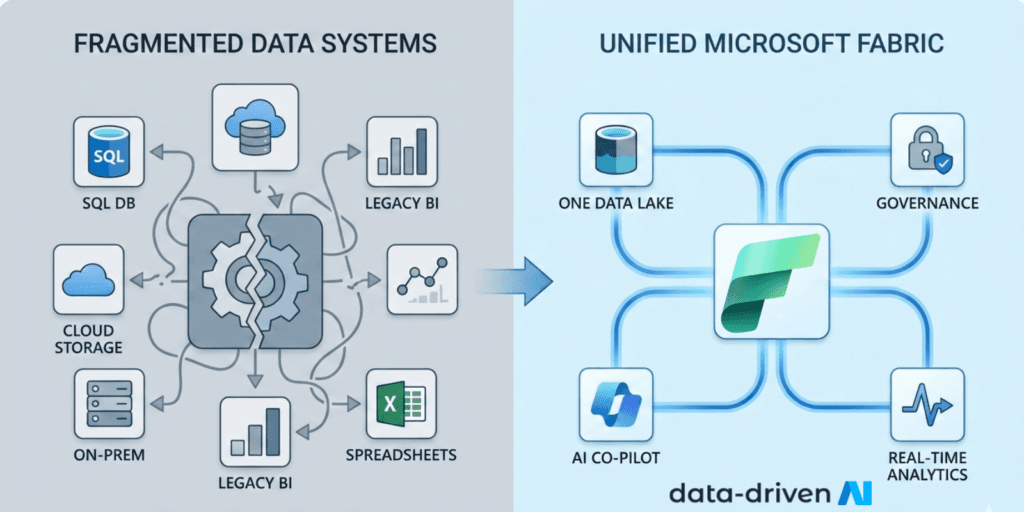
Instead of juggling fragmented tools, Fabric gives enterprises a single, governed, and AI‑accelerated analytics environment.
Microsoft has infused Copilot and Agentic AI across every Fabric workload. This allows users to:
It positions AI as a hands‑on partner, supporting productivity across engineering, analytics, and reporting.
Real‑time intelligence is no longer limited to specialised teams. With Fabric’s enhanced streaming layer, enterprises can:
This capability gives organisations the power to shift from reactive to proactive decision‑making.
Modern AI adoption requires trust, transparency, and control. Fabric delivers this through:
By embedding governance into every layer, Fabric helps enterprises scale analytics responsibly – a core theme your Teams discussions highlighted as essential for long‑term data strategy.
By consolidating disconnected analytics tools into one unified platform, organisations eliminate the delays caused by data movement, manual integrations, and tool switching. Teams can work from a single source of truth using shared data models, reusable pipelines, and integrated analytics engines. This dramatically shortens the cycle from data ingestion to actionable insights – empowering leaders to make decisions with real‑time intelligence instead of waiting days or weeks for reports.
Operating multiple analytics tools across different cloud environments increases licensing costs, infrastructure spending, and maintenance overhead. Fabric brings these capabilities into a single SaaS platform, reducing duplication and lowering total cost of ownership. With OneLake eliminating the need for multiple data copies, storage costs drop significantly. Combined with Copilot automations and AI‑powered optimisation, organisations achieve measurable financial efficiencies.
Fabric’s lake‑centric architecture (OneLake) is designed for long‑term scalability across multi‑cloud environments. By using open formats like Delta and Parquet, organisations avoid vendor lock‑in and maintain portability across Azure, AWS, and GCP. As data volumes grow, Fabric scales seamlessly – supporting advanced workloads such as real‑time intelligence, enterprise AI models, and large‑scale analytics without requiring complex re‑architecting.
With Power BI deeply embedded into Fabric, business users gain governed access to trusted datasets directly within the tools they already use – Excel, Teams, PowerPoint, and more. This enables self‑service analytics without compromising security or governance. Non‑technical users can analyse data, generate insights through Copilot, and build visualisations independently, accelerating decision‑making across the organisation.
Start by mapping where your data lives, how it moves, and which processes rely on outdated or siloed systems. Reviewing pipelines, storage locations, and reporting dependencies will help identify technical debt and integration challenges. This baseline assessment is essential for creating a clear migration roadmap.
Before adopting Fabric at scale, strengthen your organisation’s data governance framework. This includes access controls, data lineage policies, compliance rules, and AI governance guidelines. Governance ensures Fabric’s unified platform remains secure, trustworthy, and aligned with regulatory and ethical standards as your analytics footprint expands.
Fabric introduces new AI‑assisted workflows through Copilot, domain‑driven data products, and automation capabilities. To maximise value, ensure your teams – analysts, engineers, BI developers, and IT – receive training on Fabric’s features. Equipping staff with modern skills improves adoption, reduces resistance, and enhances productivity across departments.
The organisations seeing the highest ROI are those adopting a domain‑driven approach, treating data as a product rather than centralised output. Align Fabric with your business domains (finance, operations, sales, etc.) and create clear ownership models. This ensures reusable data assets, better governance, and greater agility as the organisation scales.
Microsoft Fabric in 2026 is not just a technology shift – it represents a new way of building intelligent, scalable, and responsibly governed data ecosystems. With its unified architecture, AI‑powered capabilities, and governance‑first approach, Fabric is fast becoming the enterprise backbone for modern analytics and decision intelligence.