
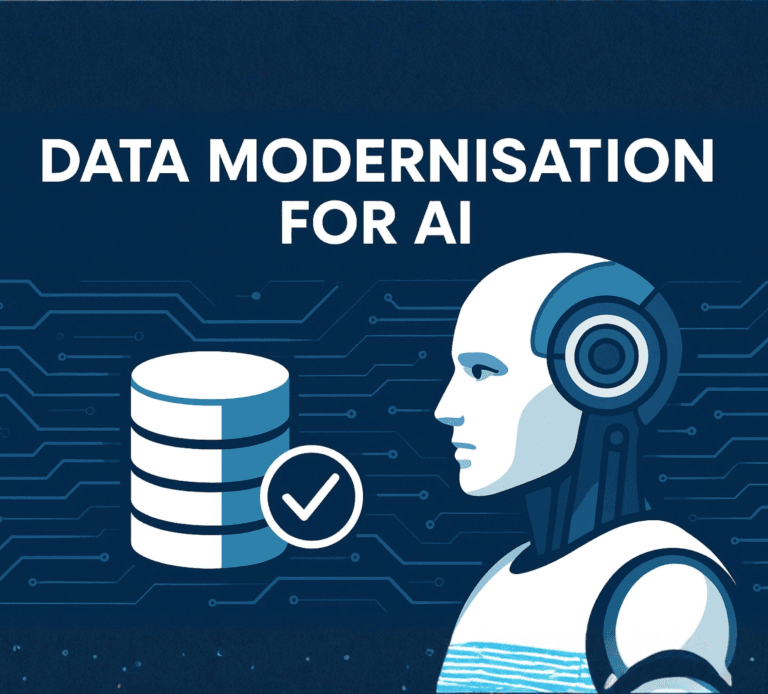
Data modernisation for AI ensures that models are trained on high-quality, consistent, and accessible data, enabling accurate and trustworthy AI-driven insights.
Artificial intelligence is now a strategic priority for many enterprises. Yet despite growing investment, a significant number of AI initiatives fail to deliver sustainable business value. The reason is rarely the AI technology itself. In most cases, the underlying issue is poor data foundations.
This is why data modernisation is the first and most critical step to successful AI adoption. Without modern, unified, and governed data, AI solutions struggle with accuracy, trust, scalability, and adoption. Enterprises that recognise this early are far more likely to turn AI from experimentation into a reliable business capability.
AI systems depend entirely on the quality, consistency, and accessibility of data. However, many enterprises still operate with data environments designed for reporting not for AI. As a result, AI initiatives often encounter challenges such as unreliable outputs, slow deployment cycles, and limited business trust.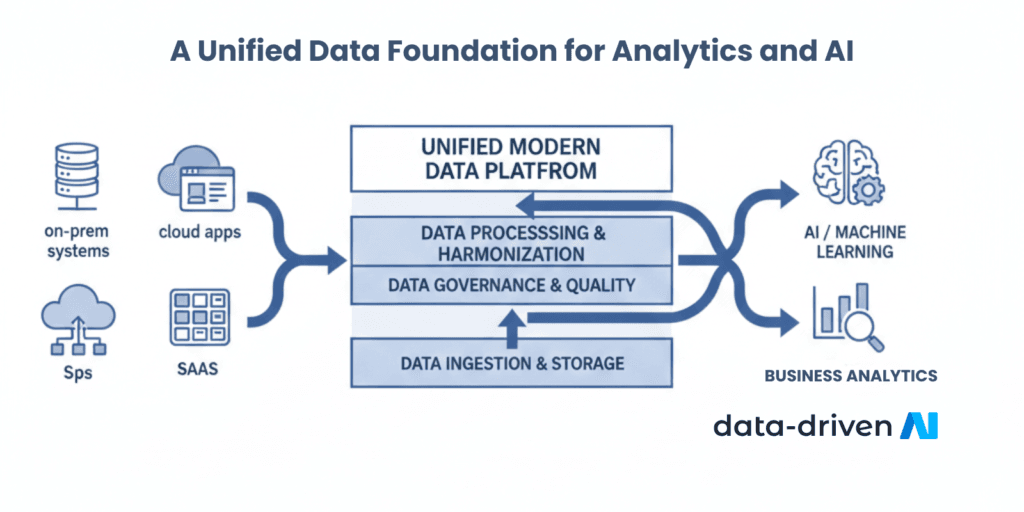
Modernising data is no longer about efficiency alone it is about making AI viable at enterprise scale.
These challenges highlight why data modernisation for AI must be addressed before organisations attempt large-scale AI deployment.
Enterprise data is spread across on‑premise systems, multiple cloud platforms, and third‑party applications. These silos make it difficult to connect data end‑to‑end, preventing AI and analytics from working with a complete, consistent view of the business.
AI relies entirely on the quality of the data it consumes. Inconsistent definitions, missing values, and unclear data ownership reduce model accuracy and lead to inconsistent insights, ultimately lowering trust in AI‑driven decisions.
Traditional data warehouses and batch‑based pipelines were not designed for real‑time analytics or AI workloads. They struggle to scale, slow down innovation, and add operational complexity as data volumes and use cases grow.
Many organisations adopt AI before putting strong governance in place. Without clear controls around access, security, and compliance, AI solutions introduce risks that often only become visible after deployment.
Platforms like Microsoft Fabric and Azure directly support data modernisation for AI by unifying analytics, governance, and AI workloads.
Microsoft Fabric plays a central role in data modernisation by unifying data engineering, analytics, real-time processing, and AI workloads within a single, governed platform. This reduces architectural complexity and ensures AI operates on trusted, consistent data.
Fabric also supports a shift from report-centric analytics to domain-driven data products, enabling better ownership, scalability, and collaboration across teams.
Azure provides the cloud foundation needed to modernise data safely and incrementally. It enables enterprises to scale compute and storage, integrate AI services, and meet enterprise-grade security and compliance requirements.
Modern data platforms embed governance across the data lifecycle, including access controls, lineage, monitoring, and policy enforcement. Governance-first design ensures AI initiatives remain compliant, explainable, and trusted as they scale.
Data Modernisation vs AI-First Approaches
Area | AI Without Data Modernisation | AI With Data Modernisation |
Data Quality | Inconsistent and unreliable | Trusted and standardised |
Time to Value | Slow and fragmented | Faster and repeatable |
AI Accuracy | Unpredictable results | Consistent and explainable |
Governance | Reactive and risky | Built-in and proactive |
Scalability | Limited | Enterprise-ready |
Enterprises that modernise data before AI consistently achieve:
Data modernisation transforms AI from isolated experiments into a repeatable, scalable capability.