
Synthetic data for AI is rapidly moving from a niche research concept to a mainstream enterprise strategy. As organisations grapple with the twin pressures of data privacy regulation and the insatiable appetite of machine learning models for training data, synthetic data offers a compelling path forward.
For Australian enterprises in particular, where the Privacy Act and sector-specific compliance frameworks place strict constraints on how personal information can be used, synthetic data is not just useful. It is increasingly essential.
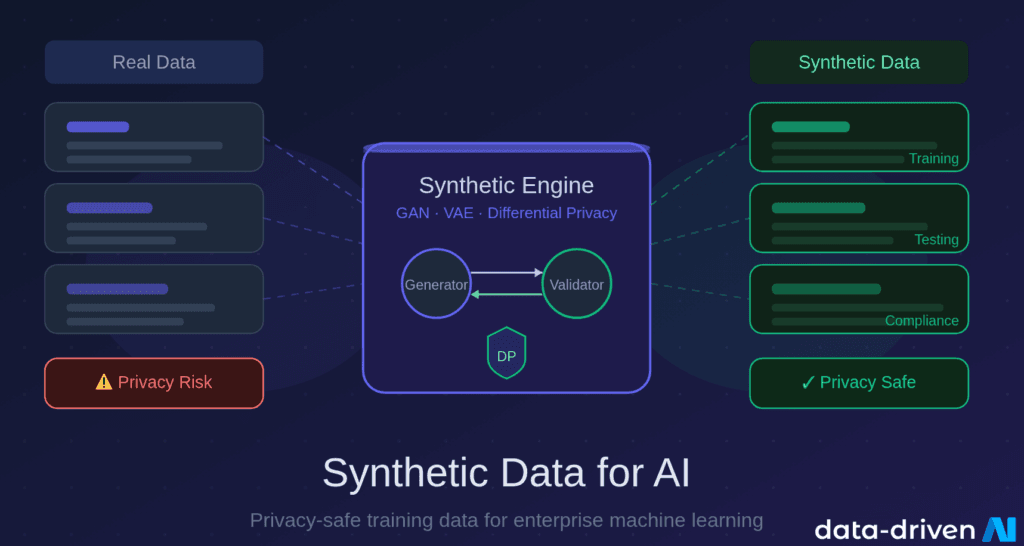
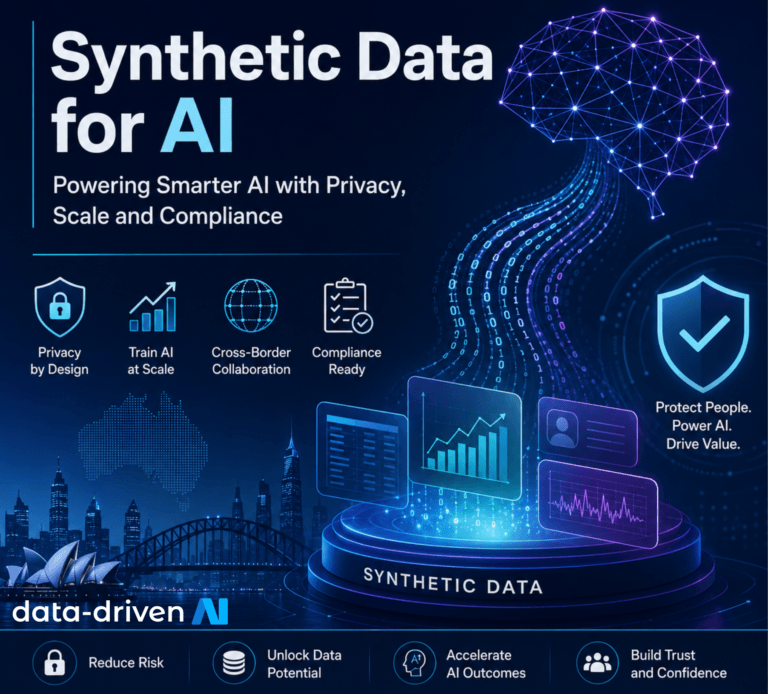
Synthetic data for AI refers to artificially generated datasets that mirror the statistical properties and structure of real-world data, without containing any actual records belonging to real individuals. It is created using techniques such as generative adversarial networks (GANs), variational autoencoders, and rule-based simulation.
The value is straightforward. You get data that behaves like the real thing for the purposes of training, testing, and validating AI models, but without the privacy risks, consent complexities, or regulatory exposure that come with handling genuine personal or sensitive information.
This matters because data scarcity is one of the biggest practical bottlenecks in enterprise AI. Teams frequently cannot access the volume or variety of labelled data they need, particularly in highly regulated industries such as healthcare, finance, and government.
Many AI projects stall because labelled training data is limited or expensive to produce. Synthetic data for AI solves this by allowing teams to generate virtually unlimited training examples that reflect the distributions and edge cases needed to build robust models.
This is particularly powerful for rare event detection, such as fraud, equipment failure, or clinical anomalies, where real-world examples are inherently scarce.
Development and QA environments traditionally require copies of production data, creating unnecessary privacy risk. Replacing those datasets with synthetic equivalents eliminates exposure while still enabling realistic testing of pipelines, interfaces, and model behaviour.
When teams or partners operate across jurisdictions with conflicting data sovereignty requirements, synthetic data can serve as a privacy-neutral alternative that enables collaboration without breaching localisation obligations.
It would be tempting to assume that synthetic data is automatically compliant. The reality is more nuanced. Poorly generated synthetic data can still leak information about individuals in the source dataset through a phenomenon called membership inference, where an attacker can determine whether a specific record was used in training.
Robust synthetic data generation requires formal privacy guarantees, such as differential privacy, along with rigorous evaluation of re-identification risk. The NIST guidelines on de-identification of personal information provide a solid technical foundation for understanding these risks and how to mitigate them.
For enterprises operating under the Australian Privacy Act or handling sensitive health and financial data, having a formal AI governance and data strategy is critical before deploying synthetic data at scale. Governance ensures that your generation pipeline, quality controls, and privacy validation processes are documented and auditable.
Synthetic data is not a standalone solution. It works best when it is embedded into a broader data strategy that defines where synthetic data is appropriate, how it is generated and validated, and how it flows through your AI development lifecycle.
Gartner has identified synthetic data as a transformative capability, noting that it will overshadow real data in AI model training by 2030. You can explore their analysis at Gartner: Synthetic Data Is the Future of AI.
Organisations that want to capitalise on this shift should start by mapping where data gaps are currently limiting AI progress, identifying which datasets carry the highest privacy risk, and evaluating which synthetic data generation methods are most appropriate for their use cases.
A structured enterprise AI strategy framework will help you situate synthetic data within your wider data architecture, define governance guardrails, and set measurable objectives so the investment delivers tangible outcomes.
For organisations already working within the Microsoft ecosystem, there are practical ways to integrate synthetic data generation into existing data pipelines on Microsoft Fabric. Notebooks in Fabric support popular Python libraries for synthetic data generation, and Lakehouse architectures provide a natural home for both real and synthetic datasets.
Pairing synthetic data capabilities with Microsoft Fabric Advanced Analytics allows teams to maintain clean separation between production and synthetic environments, track data lineage across both, and apply sensitivity labels consistently so that governance controls work regardless of dataset origin.
For most enterprises, the practical path to adopting synthetic data involves several key steps:
Synthetic data for AI represents one of the most practical and underutilised tools available to enterprise data teams today. It addresses real constraints around privacy, data scarcity, and compliance, without requiring you to compromise on the quality or realism of your training data.
As AI regulation tightens and the expectations around responsible data use continue to rise, organisations that build synthetic data capability now will have a meaningful advantage. The key is to approach it strategically, with the right governance, the right tooling, and a clear view of where it fits within your broader AI data architecture.
Ready to Build AI That Is Private, Scalable, and Trustworthy? Data-Driven helps Australian enterprises design responsible AI data strategies, including synthetic data pipelines, governance frameworks, and Microsoft Fabric analytics. Whether you are just starting your AI journey or scaling an existing platform, our team is here to help. |