
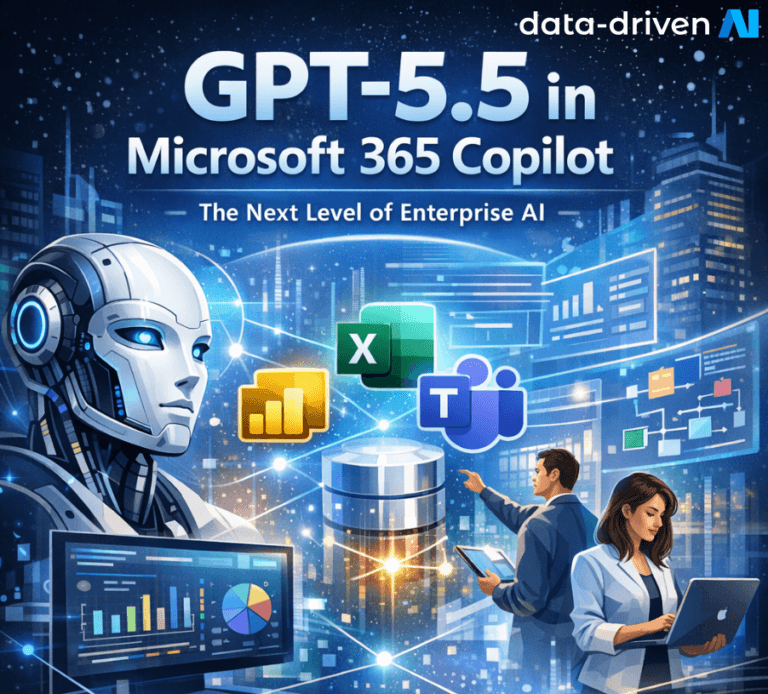
GPT-5.5 in Microsoft 365 Copilot marks a significant turning point for enterprise AI adoption. Microsoft has embedded its most capable model yet directly into the productivity suite that millions of knowledge workers rely on every day. For data teams in particular, the implications are substantial, and understanding what has changed is essential to staying competitive.
Whether your organisation is just getting started with Copilot or has already invested in a rollout, the arrival of GPT-5.5 changes the calculus around capability, governance, and ROI. Here is what your enterprise data team needs to know.
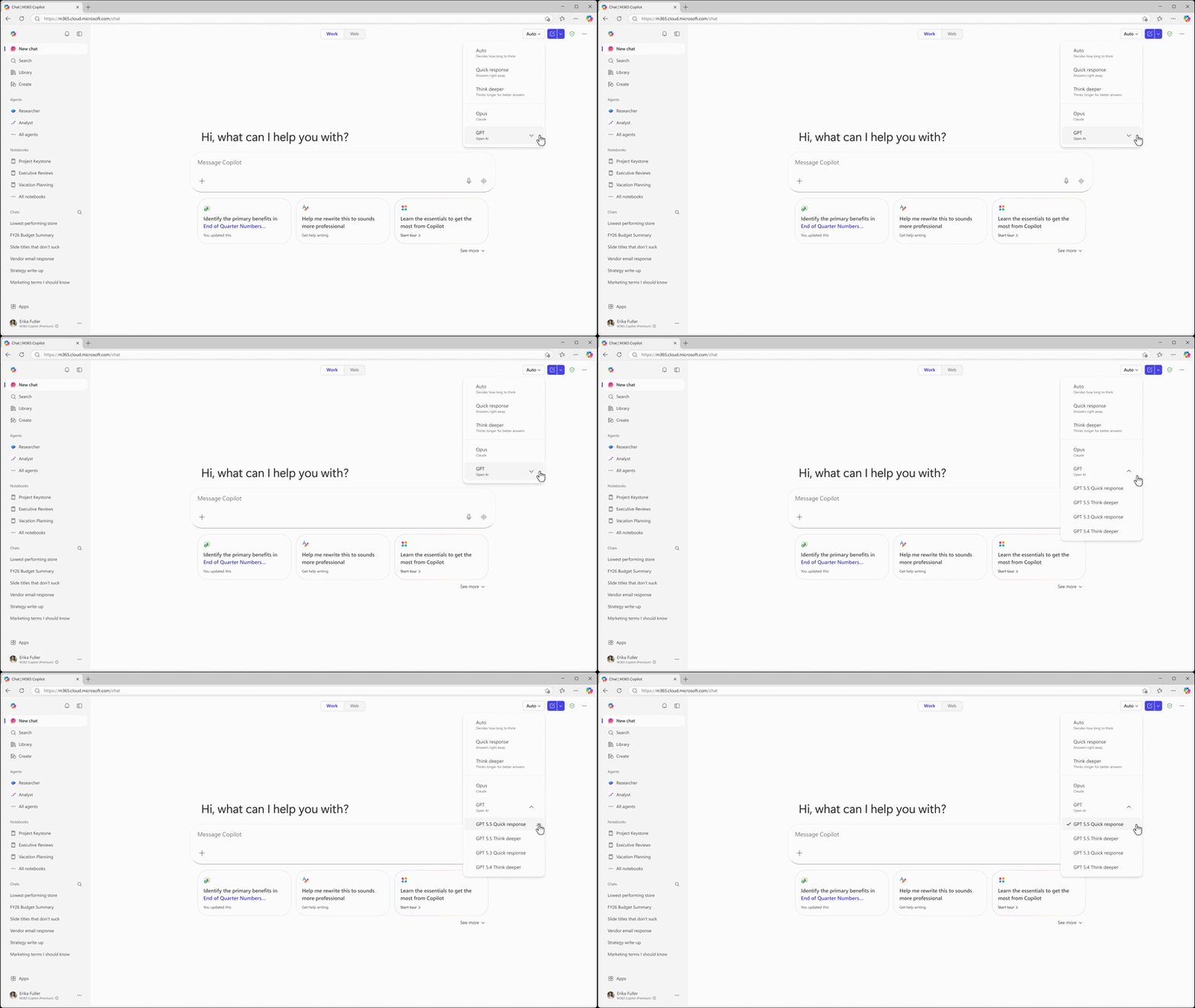
GPT-5.5 is OpenAI’s latest generation model, combining the deep reasoning of GPT-5 with faster inference speeds and improved instruction-following. Microsoft has integrated it directly into Microsoft 365 Copilot, bringing that intelligence to tools like Excel, Teams, Word, Outlook, and Power BI.
This is not a cosmetic upgrade. The model handles longer context windows, more nuanced prompts, and more reliable structured output, all of which matter greatly to data professionals who rely on Copilot to summarise reports, generate DAX queries, or interpret pipeline outputs.
One of the most practical improvements with GPT-5.5 in Microsoft 365 Copilot is its ability to reason over multi-step analytical problems. Data analysts can now ask more layered questions in Power BI or Excel and receive more accurate, contextually grounded responses.
GPT-5.5 supports a significantly longer context window than its predecessors. This means Copilot can now process more of a document, dataset, or thread before generating its output, reducing the risk of missing critical context in large enterprise data environments.
For data teams building reports, dashboards, or data pipelines with Copilot assistance, GPT-5.5 is considerably better at returning well-formed structured data. This reduces the time spent cleaning or reformatting AI-generated outputs before they can be used in production.
The upgrade to GPT-5.5 in Microsoft 365 Copilot creates real opportunities, but it also introduces new responsibilities. Here are the key areas your team should be thinking about.
Data engineers, analysts, and BI developers can expect meaningful productivity gains. Tasks that previously required several manual steps, such as writing complex formulas, generating data transformation logic, or summarising stakeholder reports, can now be completed faster and with fewer errors.
More capable AI means higher stakes for governance. As Copilot becomes more effective at surfacing and synthesising enterprise data, ensuring that the right people have access to the right information is more important than ever.
This is where a structured approach to AI governance and data strategy becomes critical. Without the right policies, role-based access controls, and audit frameworks in place, a more powerful Copilot can inadvertently expose sensitive data or generate outputs that breach compliance requirements.
GPT-5.5 is more capable, but it still performs best when users know how to prompt effectively. Upskilling your data team in Copilot-native workflows is no longer optional. The organisations that invest in Copilot literacy will extract considerably more value than those that treat it as a plug-and-play tool.
The arrival of GPT-5.5 is a good prompt, no pun intended, to revisit your broader AI strategy. Many organisations deployed Microsoft 365 Copilot as a standalone productivity initiative without fully integrating it into their data architecture or AI governance framework.
A mature enterprise AI strategy framework will help you define how Copilot fits within your wider data stack, how outputs should be validated, and how AI-assisted decisions should be documented. This is especially relevant as regulators in Australia and globally continue to develop expectations around AI accountability.
Gartner research consistently finds that organisations with a formal AI governance model are far more likely to realise sustained business value from AI investments. You can read more about practical approaches at Gartner: How to Govern AI in Your Organisation.
GPT-5.5 in Microsoft 365 Copilot also raises the ceiling for what is possible with Copilot Studio. Teams building custom agents, automated workflows, or domain-specific assistants will benefit from a more capable underlying model.
If your organisation has not yet explored Modern Business Apps and Copilot Studio, now is an ideal time to assess what can be automated or augmented through custom-built agents powered by the latest model generation.
The transition to GPT-5.5 is largely seamless for existing Microsoft 365 Copilot subscribers, but that does not mean your team should be passive. Here are practical next steps:
GPT-5.5 in Microsoft 365 Copilot is not just a model upgrade. It represents a step change in what enterprise AI can do within the tools your teams already use every day. For data professionals, the opportunity is real, but so is the need to approach it with a clear strategy, strong governance, and the right enablement in place.
Organisations that move thoughtfully and invest in the right foundations now will be well positioned to lead in an increasingly AI-driven market.
Ready to Get More From Microsoft 365 Copilot? From AI governance and strategy through to agentic automation, our team is ready to help you move fast and stay in control. |