
As Microsoft Fabric continues to mature into a unified data and analytics platform for the enterprise, one question consistently arises at the executive and architecture level: how do we deploy Fabric safely, repeatably, and at scale?
Microsoft’s announcement of official support for the fabric‑cicd tool marks a pivotal moment in answering that question. What was once a community‑driven solution is now a Microsoft‑backed, long‑term supported component of the Fabric CI/CD story – and that has important implications for organisations investing in Fabric as a strategic platform.
This is not simply a tooling update. It signals a shift in how Microsoft expects enterprises to operationalise Fabric across development, testing, and production environments.
Enterprises adopting Microsoft Fabric are rarely operating in a single workspace. Most run multiple environments – development, test, UAT, production – often across business units or regions.
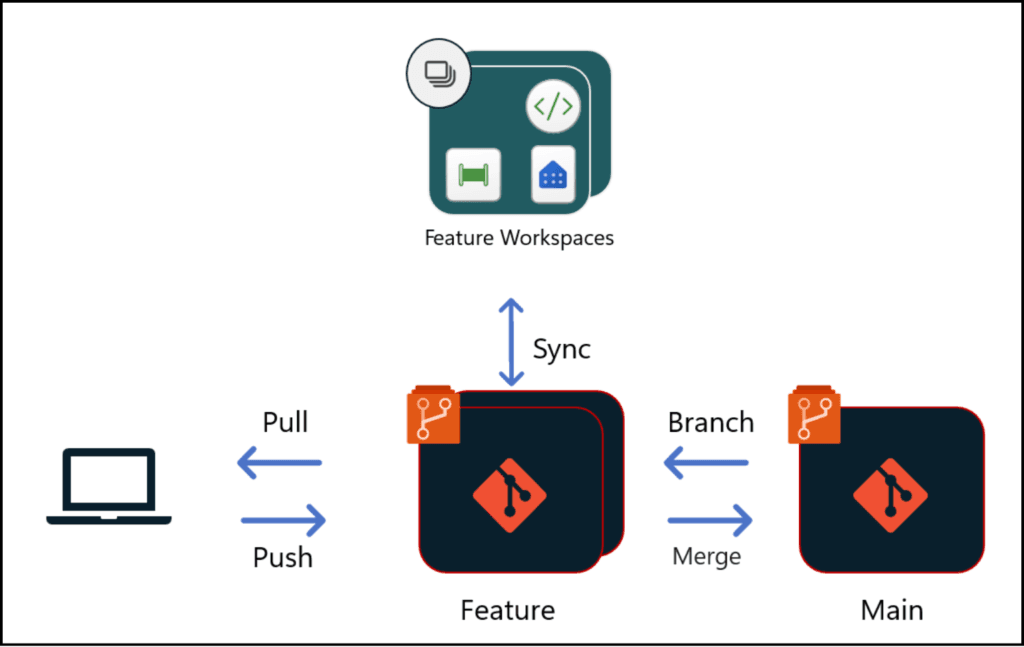
While Fabric’s native Git integration and deployment pipelines provide a strong foundation, real‑world implementations quickly surface gaps:
Microsoft explicitly acknowledges these challenges in its announcement, noting that existing approaches do not cover every deployment scenario – particularly in complex enterprise environments.
This is the context in which fabric‑cicd becomes strategically important.
The most important part of the announcement is not the tool itself – it is Microsoft’s commitment.
By officially supporting fabric‑cicd, Microsoft is confirming:
fabric‑cicd is now positioned as a first‑class, enterprise‑ready deployment option, not an experimental workaround.
For decision‑makers, this matters. Official support reduces operational risk and gives platform teams confidence that their deployment approach will not become obsolete or unsupported as Fabric evolves.
From an executive viewpoint, CI/CD is not about automation for its own sake. It is about risk reduction, scalability, and governance.
fabric‑cicd addresses several enterprise concerns directly:
The tool provides deterministic, code‑first deployments across Fabric workspaces, reducing reliance on manual steps that introduce errors and inconsistencies.
Parameterisation enables the same Fabric artefacts to move cleanly from development to production, supporting controlled release processes without duplicating work.
Complex Fabric solutions involve notebooks, pipelines, semantic models, and reports that depend on each other. fabric‑cicd manages these dependencies automatically, avoiding failed or partial deployments.
Because fabric‑cicd is scriptable and integrates with standard CI/CD platforms, it aligns naturally with enterprise DevOps practices rather than forcing teams into UI‑driven processes.
It is important to note that Microsoft is not positioning fabric‑cicd as a replacement for Fabric’s built‑in deployment pipelines or Git integration.
Instead, it acts as:
This layered approach reflects how mature data platforms are typically operated: combining native capabilities with enterprise‑grade automation where required.
For organisations evaluating or expanding their use of Microsoft Fabric, the message is clear:
Fabric is no longer just an analytics platform – it is an operational data platform that demands the same deployment discipline as application systems.
Microsoft’s endorsement of fabric‑cicd confirms that CI/CD maturity is now a core part of Fabric adoption, not an optional enhancement.
Enterprises that address deployment early will:
Those that do not risk bottlenecks, manual processes, and governance gaps as their Fabric footprint grows.
At Data‑Driven AI, we see CI/CD as a critical enabler of trusted, enterprise‑scale analytics. Official support for fabric‑cicd aligns closely with what we observe in real‑world Fabric implementations: organisations need repeatable, governed deployment patterns to unlock long‑term value from the platform.
Whether through native Fabric features, fabric‑cicd, or a combination of both, the goal is the same – making analytics delivery as reliable as the insights it produces.
As Microsoft Fabric continues its rapid evolution, this announcement represents a meaningful step toward enterprise‑grade operational maturity.
Microsoft’s official support for fabric‑cicd signals that CI/CD is now a first‑class concern in Fabric adoption – and enterprises should plan their deployment strategy accordingly. data-driven.com